
Shoulder pain becomes increasingly common in middle age, but persistent pain should not simply be accepted as a normal part of getting older.
Pain while reaching overhead, difficulty putting on a shirt, discomfort when reaching behind your back or shoulder pain that disturbs sleep can interfere with everyday activities.
The shoulder is a complex joint involving bones, muscles, tendons, ligaments and surrounding soft tissues. Several different conditions can cause similar symptoms.
That is why the first step is not necessarily an MRI.
The first step is understanding the problem and identifying the likely cause. Current clinical guidance for rotator-cuff-related shoulder disorders emphasizes history, physical examination and appropriate clinical assessment, with imaging used selectively when it is likely to influence management.
What Causes Shoulder Pain After 45?
There isn’t one single cause of shoulder pain. Some of the common possibilities include:
1. Rotator Cuff-Related Shoulder Pain
The rotator cuff is a group of muscles and tendons that helps control shoulder movement.
Pain may become noticeable while:
- Reaching overhead
- Lifting objects
- Reaching away from the body
- Sleeping in certain positions
- Performing repetitive shoulder activities
Rotator cuff tendinopathy and partial-thickness tears are among the conditions addressed by current clinical guidelines.
2. Frozen Shoulder
Frozen shoulder, also called adhesive capsulitis, commonly causes pain together with progressive restriction of shoulder movement.
You may find it difficult to:
- Comb your hair
- Reach overhead
- Put on clothes
- Reach behind your back
- Sleep comfortably
Certain medical conditions, including diabetes and thyroid disease, are associated with increased risk. Diagnosis is primarily clinical, while ultrasound or MRI may be used as supporting investigations when appropriate.
If your shoulder is progressively becoming stiffer, don’t automatically assume it is ordinary ageing. Appropriate Frozen Shoulder Treatment in Pune may begin with understanding the underlying problem and assessing your range of motion.
3. Shoulder Arthritis
Changes in the shoulder joint can contribute to:
- Pain
- Stiffness
- Reduced movement
- Difficulty with everyday activities
4. Acute Rotator Cuff Tear
A significant injury, particularly following a fall or sudden forceful movement, can sometimes cause a rotator cuff tear.
This is different from gradually developing shoulder pain and may require more urgent assessment.
5. Other Causes
Shoulder symptoms can also originate from:
- The neck
- Acromioclavicular joint
- Shoulder instability
- Calcific tendinopathy
- Other musculoskeletal conditions
Therefore, the location of your pain alone cannot establish the diagnosis.
When Should You See a Doctor for Shoulder Pain?
Consider professional assessment if your shoulder pain:
- Persists or repeatedly returns
- Affects your sleep
- Limits everyday activities
- Causes significant weakness
- Progressively reduces your range of motion
- Started after a significant injury
- Is associated with swelling or deformity
- Is accompanied by neurological symptoms
A sudden inability to lift your arm following an injury deserves particular attention because an acute structural injury may require assessment.
For persistent symptoms, consulting a Shoulder Specialist in Pune can help determine whether the problem is related to the rotator cuff, frozen shoulder, arthritis, injury or another condition.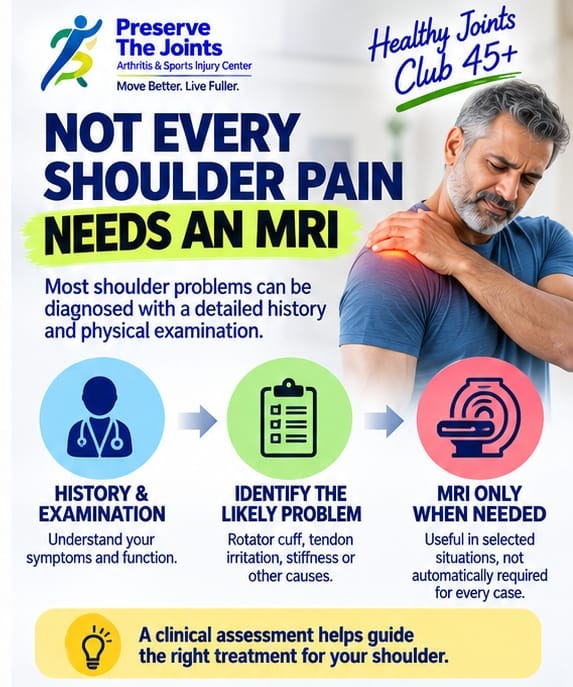
Do You Need an MRI for Shoulder Pain?
Not necessarily.
One common misconception is:
“If my shoulder hurts, I need an MRI.”
Shoulder diagnosis generally does not work this way.
An initial evaluation usually involves a detailed medical history and physical examination. Clinical guidelines recommend using diagnostic imaging selectively depending on the suspected condition and clinical situation.
For example, when acute shoulder pain raises suspicion of a rotator cuff tear after initial X-rays are negative or inconclusive, ultrasound or MRI without contrast may be appropriate in selected situations.
A useful approach is:
History → Examination → Working Diagnosis → Appropriate Investigation
Rather than:
Pain → MRI → Diagnosis
This is an important consideration when seeking Shoulder Pain Treatment in Pune, because the right investigation depends on the clinical problem.
Should You Stop Using Your Shoulder if It Hurts?
For many common non-traumatic shoulder problems, complete rest is not necessarily the long-term solution.
For rotator-cuff-related disorders, clinical practice guidelines support active rehabilitation involving exercise and education to help reduce pain and disability.
However, this does not mean you should simply push through severe pain.
A better approach is:
The right movement + the right load + gradual progression
Exercise intensity and movement should be adjusted according to your symptoms and capacity.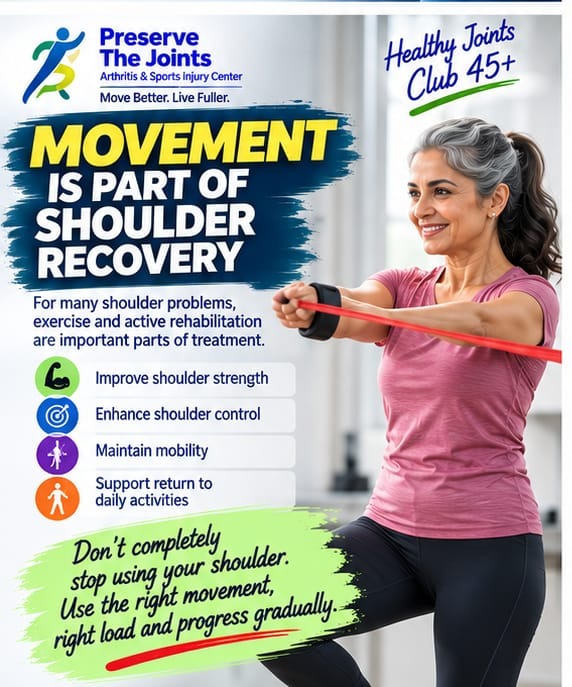
What Exercises Can Help Shoulder Pain?
There is no single exercise program suitable for everyone.
The appropriate shoulder exercises after 45 depend on the diagnosis, symptoms, range of motion, strength and current physical capacity.
Depending on the condition, rehabilitation may include:
Shoulder Strengthening
Progressive strengthening can help improve the capacity of the muscles supporting the shoulder.
Scapular Control
Exercises targeting the muscles around the shoulder blade can help improve control during arm movement.
Range-of-Motion Exercises
These may be particularly useful when stiffness is an important part of the problem.
Functional Exercises
Gradually returning to movements required for work, sport and daily activities can be an important part of rehabilitation.
A professional Shoulder Rehabilitation in Pune program can be tailored according to the underlying condition and your functional goals.
What About Frozen Shoulder?
Frozen shoulder deserves separate consideration because it typically involves both pain and substantial restriction of movement.
You may experience difficulty with:
- Combing your hair
- Reaching overhead
- Putting on clothes
- Reaching behind your back
- Sleeping comfortably
Current clinical guidance supports clinical diagnosis and describes several nonsurgical treatment options, including exercise-based approaches and selected injection treatments.
If your shoulder is becoming increasingly stiff, professional evaluation can help determine whether you may have frozen shoulder or another condition.
Can Shoulder Pain Be Prevented After 45?
Not every shoulder problem can be prevented.
However, maintaining physical activity, muscle strength and appropriate shoulder function can help you remain capable of performing everyday activities.
Useful habits include:
- Stay physically active
- Maintain upper-body strength
- Avoid sudden increases in training load
- Use appropriate exercise technique
- Progress resistance gradually
- Address persistent pain early
- Avoid prolonged complete inactivity when movement is safe
Contemporary shoulder guidelines also support healthy lifestyle habits and gradual exercise progression as part of care.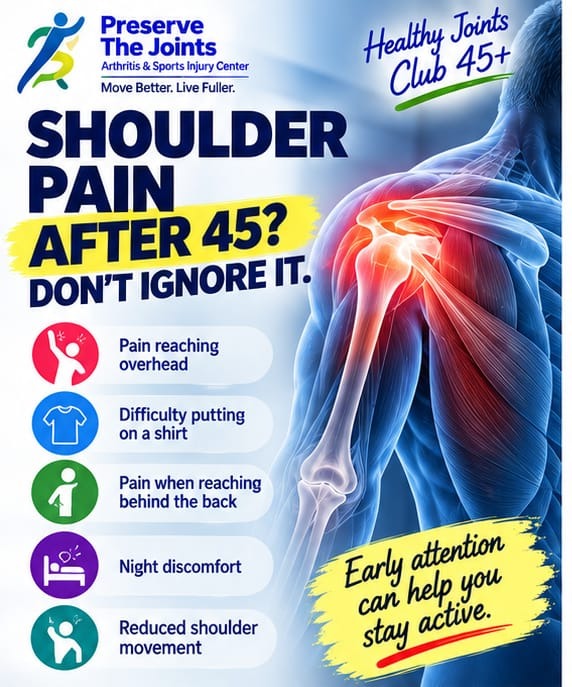
5 Shoulder Habits to Adopt After 45
1. Don’t Ignore Persistent Pain
Shoulder pain that keeps returning deserves attention.
2. Don’t Automatically Ask for an MRI
First establish what the clinical problem may be.
3. Don’t Completely Stop Using Your Shoulder
Appropriate movement is often an important part of rehabilitation.
4. Don’t Increase Exercise Load Suddenly
Give muscles and tendons time to adapt.
5. Don’t Assume Every Shoulder Problem Needs Surgery
Many shoulder conditions can initially be managed with appropriate nonsurgical treatment, although selected structural problems may require surgical consideration.
A Simple Shoulder Health Checklist After 45
Ask yourself:
☑️ Can I comfortably raise both arms overhead?
☑️ Can I put on a shirt without significant difficulty?
☑️ Can I reach behind my back?
☑️ Can I sleep comfortably on either side?
☑️ Do I have reasonable shoulder strength?
☑️ Has my shoulder movement recently decreased?
☑️ Do I have persistent or worsening pain?
If you notice a significant change in shoulder function, don’t simply attribute it to age.
When Is Shoulder Pain an Urgent Problem?
Seek prompt medical assessment when shoulder pain is associated with:
- Major trauma
- Obvious deformity
- Sudden major loss of function
- New significant weakness
- Numbness or neurological symptoms
- Fever or signs of infection
- Severe unexplained pain
Also, shoulder-area discomfort accompanied by chest pain, breathlessness, sweating or other cardiac-type symptoms should be evaluated urgently rather than automatically assumed to be a musculoskeletal shoulder problem.
Frequently Asked Questions
Is shoulder pain normal after 45?
Shoulder pain becomes more common with age, but persistent or function-limiting pain should not automatically be considered a normal part of ageing.
Do I need an MRI for shoulder pain?
Not necessarily. Initial assessment generally includes medical history and physical examination, with imaging selected according to the clinical situation.
Can exercise help rotator cuff pain?
Yes. Active, exercise-based rehabilitation is an important component of nonsurgical management for many rotator-cuff-related shoulder problems.
Should I stop exercising if my shoulder hurts?
Not automatically. The appropriate response depends on the cause and severity of the pain. Exercise may need to be modified rather than completely stopped.
Does shoulder pain always mean a rotator cuff tear?
No. Shoulder pain can have many causes, including rotator-cuff-related pain, frozen shoulder, arthritis, neck-related pain and other conditions.
Can a rotator cuff tear exist without pain?
Yes. Imaging abnormalities can occur in people without shoulder symptoms, which is why imaging findings should be interpreted alongside clinical assessment.