

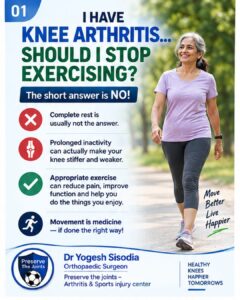
If you have been diagnosed with knee osteoarthritis, you may have heard that exercise could “wear out” your knee further.
This is one of the most common concerns among people with knee arthritis.
The good news is that, for most people with knee osteoarthritis, appropriately prescribed exercise is an important part of management. The key is not simply to exercise more, but to choose the right exercise, intensity and progression for your knee, symptoms and goals.
Knee osteoarthritis affects more than cartilage. Changes can occur throughout the joint, including the cartilage, underlying bone, synovium, meniscus and surrounding muscles and tissues. These changes can contribute to pain, stiffness, reduced strength and difficulty with everyday activities.
When pain causes you to become less active, another problem can develop:
Pain → less activity → muscle weakness → reduced function → more difficulty moving.
Exercise can help break this cycle.
Can Exercise Really Reduce Knee Pain?
Yes, although the amount of improvement varies from person to person.
Research has found that different forms of exercise, including aquatic exercise, cycling, resistance training and other exercise programs, can improve pain and function in people with knee osteoarthritis.
However, exercise is not a miracle cure, and it does not guarantee the same results for everyone.
The evidence supports exercise as an important part of an individualized knee arthritis management plan.
If you are considering knee arthritis treatment in Pune, exercise should therefore be viewed as one component of comprehensive care rather than as a standalone solution.
What Are the Best Exercises for Knee Arthritis?
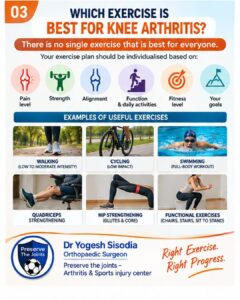
There is no single exercise that is best for every person with knee osteoarthritis.
Clinical guidelines include several forms of exercise, such as:
- Walking and aerobic exercise
- Strengthening exercises
- Neuromuscular training
- Aquatic exercise
The most appropriate combination depends on your symptoms, strength, mobility, fitness, other health conditions and personal goals.
Let’s look at some common options.
1. Strength Training
Strength training is an important part of exercise for knee arthritis.
It can target muscles that support movement and everyday function, including:
- Quadriceps
- Hamstrings
- Gluteal muscles
- Calf muscles
- Hip abductors and other hip muscles
Research has shown that resistance training can improve symptoms, function and lower-limb muscle strength in people with knee osteoarthritis.
However, more resistance is not necessarily better. The weight, repetitions, frequency and progression should be adjusted to the individual.
2. Walking
Walking is a simple and accessible form of aerobic activity for many people with knee arthritis.
If you are currently inactive, you don’t have to begin with a long walk.
Instead:
Start with a manageable amount → monitor your symptoms → gradually increase activity.
If walking repeatedly causes significant pain or swelling, your exercise program may need modification and your knee may need assessment.
3. Cycling
Cycling, particularly stationary cycling, can provide cardiovascular exercise while allowing you to control the resistance and duration.
It may be useful for people who find prolonged walking uncomfortable.
Start with a comfortable resistance and duration instead of immediately trying to achieve a particular distance or intensity.
4. Swimming and Aquatic Exercise
Exercising in water can reduce the effective load on the joints while allowing you to work on movement, strength and cardiovascular fitness.
Aquatic exercise is included among recommended exercise approaches for knee osteoarthritis and may be particularly useful for people who find land-based exercise difficult.
5. Balance and Neuromuscular Exercises
Knee arthritis can affect not only physical function but also confidence in movement.
Balance and neuromuscular exercises can be incorporated into rehabilitation when appropriate.
Examples include:
- Single-leg balance
- Step-ups
- Sit-to-stand movements
- Controlled functional movements
These exercises should be progressed according to your ability and safety.
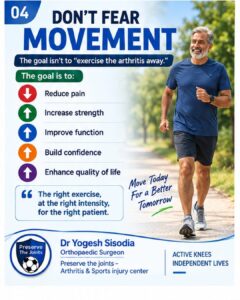
Should You Stop Exercising if Your Knee Hurts?
Not necessarily.
Some discomfort during or after exercise does not automatically mean that you are damaging your knee.
However, there is an important difference between manageable exercise-related symptoms and significant or progressively worsening symptoms.
If exercise repeatedly produces:
- Significant pain
- Increasing swelling
- Loss of function
- Persistent worsening of symptoms
the exercise, intensity or volume may need to be modified.
New, severe or unexplained symptoms should be assessed rather than simply ignored.
Does Exercise Damage the Remaining Cartilage?
This is one of the biggest fears among people with knee osteoarthritis.
Many patients ask:
“If I keep using my knee, won’t I wear out the remaining cartilage?”
The relationship between exercise and joint loading is more complicated than simply saying that more movement equals more cartilage damage.
Research suggests that exercise can alter knee loading while improvements in muscle strength and symptoms can occur at the same time. The available evidence does not support the simple conclusion that appropriately prescribed exercise inevitably damages an arthritic knee.
So instead of asking:
“Should I exercise?”
A better question is:
“What type of exercise, how much and at what intensity is appropriate for my knee?”
Can You Do Squats and Climb Stairs With Knee Arthritis?
Having knee arthritis does not automatically mean that you must stop squatting or climbing stairs.
However, the appropriate depth, resistance and technique depend on several factors, including:
- Severity of arthritis
- Pain
- Muscle strength
- Mobility
- Alignment
- Previous injuries
- Functional goals
A supervised rehabilitation program can help determine how these movements can be performed safely and progressed appropriately.
How Can You Exercise Safely With Knee Arthritis?
Keep these principles in mind:
Start Gradually
Don’t suddenly increase your exercise volume or intensity.
Focus on Technique
Perform exercises with controlled and appropriate movement.
Monitor Your Symptoms
Pay attention to persistent increases in pain, swelling or loss of function.
Build Strength
Stronger lower-limb muscles can improve physical capacity and everyday function.
Stay Consistent
Regular, appropriate activity is generally more useful than occasional intense workouts.
Adjust When Necessary
If an exercise repeatedly aggravates your symptoms, modify the movement, intensity or volume.
A Simple Weekly Approach
Your exact program should be individualized, but a balanced exercise routine can include:
Strength training
→ Build lower-limb and hip strength.
Aerobic exercise
→ Walking or cycling according to your ability.
Balance training
→ Improve control and confidence.
Mobility work
→ Maintain comfortable movement.
Aquatic exercise
→ An alternative when land-based exercise is uncomfortable.
The goal isn’t to complete the hardest workout.
The goal is to build capacity while keeping symptoms manageable.
Frequently Asked Questions
Can exercise worsen knee arthritis?
Appropriately prescribed exercise is generally an important component of knee osteoarthritis management. However, exercise type, intensity and volume should be individualized.
What is the best exercise for knee arthritis?
There is no single best exercise for everyone. Walking, aerobic activity, strengthening, neuromuscular training and aquatic exercise are among the approaches supported by clinical recommendations.
Can I walk if I have knee arthritis?
Many people with knee arthritis can walk and benefit from remaining physically active. The appropriate amount depends on symptoms and physical capacity.
Is strength training good for knee arthritis?
Yes. Resistance training can improve lower-limb muscle strength and may improve pain and function in people with knee osteoarthritis.
Should I stop exercising if my knee hurts?
Not necessarily. Exercise may need to be modified if it causes significant or persistent worsening of pain or swelling. New or severe symptoms should be clinically assessed.