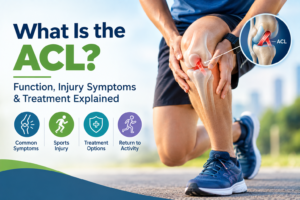
If you have injured your knee while playing football, cricket, badminton, basketball, tennis, kabaddi, running or another sport, you may have heard the term ACL tear.
But what exactly is the ACL? Why is it so important for athletes? And does every ACL injury require surgery?
The ACL, or anterior cruciate ligament, is one of the major ligaments inside the knee. It connects the thigh bone (femur) to the shin bone (tibia) and plays an important role in controlling knee movement and stability.
For athletes, understanding the ACL can help explain why some knee injuries require more than simply resting until the pain disappears.
Where Is the ACL Located?
The ACL is located deep inside the knee joint between the femur and tibia.
It works together with several other structures, including:
- Posterior cruciate ligament (PCL)
- Medial and lateral collateral ligaments
- Menisci
- Articular cartilage
- Muscles around the hip and knee
- Other stabilizing structures
The ACL has complex three-dimensional anatomy. Its fibres are traditionally described in relation to anteromedial and posterolateral functional bundles, although the native ligament is more complex than a simple two-bundle structure.
This anatomy is one reason modern ACL reconstruction aims to restore the functional anatomy of the native ligament.
What Does the ACL Actually Do?
The ACL helps control forward movement of the tibia relative to the femur and contributes significantly to rotational stability of the knee.
This becomes especially important during sports that involve:
- Sprinting
- Sudden stopping
- Cutting
- Pivoting
- Jumping
- Landing
- Rapid changes in direction
For example, a footballer may sprint, suddenly decelerate, plant the foot, change direction and accelerate again.
A badminton player may move sideways, stop, lunge and quickly push off in another direction.
A basketball player may jump, land, decelerate and pivot.
These movements place complex demands on the knee, and the ACL works with the muscles and other structures around the knee to help maintain stability.
Why Are ACL Injuries Common in Sports?
An ACL injury can occur through contact or without direct contact.
A typical non-contact injury may happen when an athlete:
- Suddenly decelerates
- Changes direction rapidly
- Lands awkwardly
- Pivots with the foot planted
- Loses control during a cutting movement
This makes ACL injuries particularly relevant in sports involving jumping, cutting, pivoting and rapid changes in direction.
For athletes, the important question after an ACL injury is not simply whether they can walk.
The bigger question is:
Can the knee remain stable when exposed to the demands of the sport?
What Are the Common ACL Injury Symptoms?
An ACL injury may produce several symptoms, although symptoms can vary from person to person.
Common ACL injury symptoms include:
- A sudden “pop” in the knee
- Rapid swelling
- Knee pain
- Difficulty continuing the activity
- Reduced range of motion
- A feeling of instability
- Episodes of the knee “giving way”
An important point is that a person may still be able to walk after completely tearing the ACL.
Walking in a straight line is very different from sprinting, pivoting, cutting or landing during sport. Therefore, being able to walk after an injury does not necessarily mean that the knee is stable enough for athletic activity.
What Happens During ACL Reconstruction?
When reconstruction is indicated, the torn ACL is reconstructed using a tendon graft.
Potential graft options include:
- Hamstring tendon
- Patellar tendon
- Quadriceps tendon
- Peroneus longus tendon
- Other graft options in selected circumstances
There is no single graft that is automatically appropriate for every athlete. Graft selection can depend on age, sport, activity level, anatomy, associated injuries, previous surgery and other individual considerations.
For someone researching ACL reconstruction in Pune, understanding the reason for reconstruction and the rehabilitation process is just as important as understanding the surgical procedure itself.
When Can You Return to Sport After ACL Surgery?
One of the most common questions athletes ask is:
“Doctor, when can I play again?”
The answer should not simply be “six months.”
Return to sport is better viewed as a continuum:
Return to participation → Return to sport → Return to performance
Assessment should consider physical examination, strength, functional testing, sport-specific demands and psychological readiness. Purely time-based clearance is not recommended.
The goal is not simply that the surgery has healed.
The goal is that:
The knee is ready to handle the demands of the sport.
Why See an ACL Specialist in Pune?
An ACL injury can affect more than your ability to walk. For athletes, the injury can influence sprinting, deceleration, cutting, pivoting, jumping and landing.
An ACL specialist in Pune can assess the injury in the context of your age, sporting activity, knee stability, associated injuries and future goals.
The aim is to determine an appropriate treatment pathway rather than assuming that every ACL tear requires the same approach.
The Most Important Message for Patients
An ACL tear is not simply an MRI diagnosis.
The right treatment depends on:
- Your age
- Your sport
- Your knee
- Associated injuries
- Your goals
The objective of modern ACL care is not simply to reconstruct a ligament. It is to help the patient achieve a stable, functional knee and safely return to the activities and sports that matter to them.
Conclusion
The ACL is a small but highly important component of knee stability. For athletes, it plays an important role during running, deceleration, cutting, pivoting and landing.
An ACL tear therefore deserves more than simply looking at an MRI report.
It requires consideration of the person, knee, sport, associated injuries and goals.
If you have experienced a suspected ACL injury, an assessment by a sports orthopaedic surgeon in Pune can help determine an appropriate treatment pathway based on your individual needs.
Frequently Asked Questions
Can I walk if my ACL is torn?
Yes. Some people can walk relatively normally after an ACL tear. However, walking does not necessarily demonstrate adequate stability for pivoting or cutting sports.
Can an ACL tear heal on its own?
Some patients can be managed with structured rehabilitation, while others, particularly those with instability and high sporting demands, may require reconstruction. Treatment should be individualized.
Can I play sports with a torn ACL?
Some patients may participate in selected activities, but sports involving pivoting, cutting and rapid changes of direction place greater demands on an ACL-deficient knee. Recurrent instability may also affect other knee structures.
Does every ACL tear require surgery?
No. Activity level, sport, knee instability, associated injuries and individual goals all contribute to the treatment decision.
Is ACL surgery the end of treatment?
No. Rehabilitation is an essential component of recovery. Strength, movement quality, functional performance and psychological readiness are important when progressing back to sport.
Is six months enough to return to sport?
Time alone should not determine return to sport. A criteria-based assessment involving physical and functional factors and psychological readiness is recommended.