
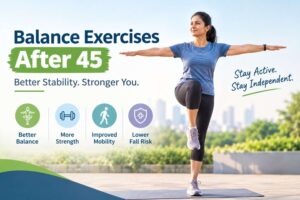
Balance is something many people rarely think about until everyday movements start feeling less steady. Walking on an uneven surface, stepping off a curb, climbing stairs, getting out of a chair or changing direction quickly all require your body to maintain stability.
Balance is not controlled by one body part. It depends on the interaction between muscle strength, vision, sensation, coordination and the body’s balance systems. As we age, maintaining these abilities becomes increasingly important for mobility, confidence and independence.
The good news is that balance exercises after 45 can become part of a regular fitness routine. Balance is a physical skill that can be trained, and structured physical activity has been shown to improve strength and postural balance in middle-aged adults.
Why Does Balance Matter After 45?
Everyday activities require balance, including:
- Walking
- Turning
- Climbing stairs
- Getting up from a chair
- Reaching for objects
- Walking on uneven surfaces
- Getting in and out of a vehicle
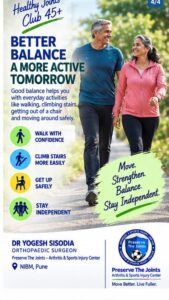
Good balance helps your body respond when your position changes unexpectedly. For example, stepping off a curb requires your ankle, knee, hip and trunk muscles to quickly control your movement.
Balance also plays an important role in maintaining mobility and independence as you get older.
What Controls Your Balance?
Balance depends on several systems working together.
1. Muscle Strength
Your legs, hips and trunk provide the physical support needed to keep your body stable.
2. Vision
Your eyes provide information about your surroundings and help your brain understand where your body is positioned.
3. Sensation
Your feet, joints and muscles provide information about body position and movement.
4. Coordination
Your nervous system processes information from these systems and produces an appropriate movement response.
This is why having strong muscles alone does not automatically guarantee excellent balance.
Why Strong Muscles Help Improve Balance
Imagine unexpectedly stepping off a curb. Your body needs to control your ankle, knee, hip and trunk quickly.
If your lower-limb muscles are weak, controlling this movement may become more difficult.
Strength is important for everyday activities such as:
- Rising from a chair
- Climbing stairs
- Walking
- Carrying objects
- Getting in and out of a vehicle
- Recovering from a small loss of balance
Evidence also links greater physical activity with better skeletal muscle strength and power in older adults.
Can Exercise Improve Balance?
Yes. Exercise-based interventions have been associated with improvements in both static and dynamic balance, balance confidence and other functional outcomes in older adults.
Different approaches may contribute, including resistance training, aerobic activity and balance-focused exercises. There is not one exercise that is universally suitable or “best” for everyone.
Your exercise program should match your current ability and goals.
A Simple Balance Checklist After 45
Ask yourself:
- Can I get up from a chair easily?
- Can I walk comfortably without feeling unsteady?
- Can I climb stairs confidently?
- Do I regularly perform strength exercises?
- Do I practise movements that challenge my balance?
- Am I physically active throughout the week?
- Have I noticed any recent deterioration in my balance?
If your balance has noticeably changed, don’t automatically assume it is simply because of age.
Balance changes can sometimes be associated with vision problems, medication effects, neurological conditions, inner-ear disorders, muscle weakness or musculoskeletal problems. Finding the underlying cause can help determine the appropriate approach.
When Should You Seek Medical Advice?
Consider seeking professional medical assessment if you experience:
- Repeated falls
- New or rapidly worsening balance problems
- Frequent dizziness or spinning sensations
- New weakness or numbness
- Increasing difficulty walking
- Loss of coordination
- A significant change in your usual mobility
Balance problems should not always be addressed simply by doing more exercises. Identifying the underlying cause is important.
The Healthy Joints Club 45+ Approach
Healthy ageing isn’t only about avoiding disease. It is also about maintaining the physical capacity needed to live your life.
A balanced approach focuses on:
Strong muscles.
Good balance.
Regular movement.
Better mobility.
Greater independence.
You don’t have to wait until 65 to begin working on these abilities. Building strength, mobility and balance can start in your 40s and continue throughout life.
Conclusion:
Balance is not something you simply have or don’t have. It is influenced by strength, coordination, sensory information and regular practice.
After 45, make balance part of your overall fitness strategy:
- Move regularly
- Strengthen your muscles
- Challenge your balance safely
- Progress gradually
Move Better. Stay Strong. Age Well.
Frequently Asked Questions
Is balance training only for people over 65?
No. Balance is a functional skill relevant throughout adulthood. Research involving adults aged 40–60 has found that structured physical activity can improve postural balance and lower-limb strength.
Is walking enough to improve balance?
Walking is an excellent form of physical activity, but walking alone may not provide all the challenges needed to train balance and strength. A well-rounded program can include aerobic activity, resistance training, balance and functional exercises.
Should I practise standing on one leg every day?
Not necessarily. Single-leg standing is only one type of balance exercise. It should be appropriate for your ability and performed safely, particularly when you are starting.
Can strength training improve balance?
Yes. Research in middle-aged adults indicates that strength-focused exercise can improve both strength and postural balance.
Does poor balance mean I have a disease?
No. Balance can be affected by many factors, including fitness, strength, vision, sensation and age-related changes. However, new or rapidly worsening balance problems should be medically assessed rather than automatically considered normal ageing.