Acute vs Overuse Sports Injuries: What Is the Difference?
A Sports Medicine Guide to Causes, Treatment, Recovery & Injury Prevention
Did your injury happen suddenly—or did your body gradually start telling you that something was wrong?
Understanding the difference between acute vs overuse sports injuries is an important part of sports medicine.
An ankle sprain after a sudden twist is very different from Achilles tendon pain that develops progressively over several weeks.
However, sports injuries do not always fit neatly into one category.
Some injuries that appear to happen suddenly may occur after a period of increasing training load, fatigue, inadequate recovery or insufficient preparation.
Understanding how an injury developed can help athletes, coaches and healthcare professionals make better decisions about treatment, rehabilitation, training and sports injury prevention.
What Is an Acute Sports Injury?
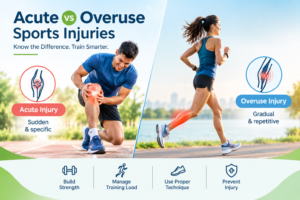
An acute sports injury generally occurs suddenly following an identifiable event or mechanism.
The athlete can often remember the exact moment the injury occurred.
For example:
“I planted my foot, changed direction and felt my knee give way.”
Or:
“I landed on another player’s foot and twisted my ankle.”
Common examples of acute sports injuries include:
- ACL tears
- Ankle sprains
- Hamstring strains
- Muscle injuries
- Shoulder dislocations
- Fractures
- Joint injuries following a collision
- Acute meniscal injuries
The mechanism of injury can provide important information during assessment.
For example, a footballer who develops a knee injury while changing direction may require a different diagnostic approach from an athlete who injures the knee following a direct collision.
What Is an Overuse Sports Injury?
An overuse sports injury generally develops gradually because a tissue or body region is repeatedly exposed to loading.
Unlike an acute injury, there may not be one specific moment when the injury occurred.
An athlete may initially say:
“It started hurting after training.”
Then, over the following days or weeks:
“It became worse.”
Overuse injuries can affect:
- Tendons
- Bones
- Muscles
- Joints
- Growth plates in young athletes
Common examples include:
- Achilles tendinopathy
- Patellar tendinopathy
- Bone stress injuries
- Stress fractures
- Medial tibial stress syndrome
- Patellofemoral pain
- Shoulder overuse conditions in swimmers and throwers
- Tendinopathies in racket-sport athletes
Excessive loading, inadequate recovery and inadequate physical preparation can contribute to overuse injury risk.
Can an Acute Injury Have an Overuse Component?
Yes.
This is an important concept for athletes and coaches.
Imagine an athlete who suddenly increases their training volume.
They train hard for several consecutive days.
Recovery is inadequate.
Fatigue begins to accumulate.
Then the athlete performs a maximal sprint and experiences a hamstring injury.
The injury appears to be acute because the athlete felt pain during one particular sprint.
However, the events leading up to that sprint may have included:
- Increased training volume
- Increased intensity
- Inadequate recovery
- Accumulated fatigue
- Insufficient preparation
Therefore, when assessing an acute injury, it can be useful to ask two questions:
What happened at the moment of injury?
And:
What happened during the weeks leading up to the injury?
A detailed training history can therefore be valuable during sports medicine assessment.
The Important Concept: Load vs Capacity
One useful way to understand sports injury risk is to consider the relationship between the load placed on the body and the body’s capacity to tolerate that load.
What Is Training Load?
Load can include:
- Training
- Competition
- Running
- Sprinting
- Jumping
- Throwing
- Lifting
- Repetitive movement
- Travel
- Other physical and psychological demands
What Is Capacity?
Capacity refers to the athlete’s ability to tolerate and adapt to those demands.
It can be influenced by:
- Strength
- Fitness
- Previous training
- Tissue health
- Previous injury
- Recovery
- Sleep
- Nutrition
- Age
- Training history
This relationship is dynamic. A rapid increase in training or competition demands combined with inadequate recovery may increase injury risk.
The goal is not to avoid training.
The goal is to progressively build the capacity needed to tolerate the demands of your sport.
Why Does Training Load Matter?
Training is essential for athletic development.
Too little training may leave an athlete underprepared.
Appropriately progressed training allows the body to adapt and build capacity.
However, excessive or poorly managed loading—particularly when combined with inadequate recovery—can contribute to fatigue, under-recovery and injury.
Therefore, athletes should not think:
“Train as little as possible to avoid injury.”
Instead:
“Train enough to improve capacity while managing load and recovery appropriately.”
The relationship between training load and injury is complex. Training load should not be viewed as one number that automatically predicts whether an athlete will get injured.
What Causes Overuse Sports Injuries?
Overuse injuries usually develop through an interaction of several factors.
1. Sudden Changes in Training
Examples include:
- Rapidly increasing running distance
- Suddenly adding sprint sessions
- Increasing lifting volume
- Starting intensive preseason training
A body that has not been prepared for a new workload may struggle to tolerate the increased demand.
2. Repetitive Loading
Repeating the same movement without adequate recovery can increase stress on particular tissues.
Examples include:
- Repetitive throwing
- High-volume running
- Repeated jumping
- Swimming strokes
- Repeated striking
3. Inadequate Recovery
Recovery is an essential part of training.
Important factors include:
- Sleep
- Rest days
- Nutrition
- Hydration
- Training schedule
- Competition congestion
Training and recovery need to be considered together rather than separately.
4. Inadequate Physical Preparation
An athlete may suddenly be exposed to demands that exceed their current conditioning.
For example, a recreational runner who suddenly starts preparing for a half marathon may expose the lower limbs to substantially more running load than they have previously experienced.
5. Previous Injury
Previous injury can influence strength, movement, confidence and tissue capacity.
Therefore, previous injuries should be considered when designing rehabilitation and injury-prevention programs.
Common Acute Sports Injuries by Sport
Different sports have different injury patterns.
Football
- ACL injuries
- Ankle sprains
- Hamstring strains
- Groin injuries
- Knee injuries
Basketball
- Ankle sprains
- ACL injuries
- Patellar tendon problems
- Muscle injuries
Kabaddi
- Knee injuries
- Ankle injuries
- Shoulder injuries
- Muscle strains
- Contact-related injuries
Athletics
- Hamstring injuries
- Muscle strains
- Stress injuries
- Tendinopathies
Boxing
- Hand and wrist injuries
- Shoulder injuries
- Facial injuries
- Acute traumatic injuries
Wrestling and Judo
- Shoulder injuries
- Knee injuries
- Ankle injuries
- Ligament injuries
- Contact injuries
The exact injury pattern varies according to factors such as age, training level, position, technique, event and individual characteristics.
Common Overuse Sports Injuries by Sport
Running
- Achilles tendinopathy
- Patellofemoral pain
- Tibial bone stress injuries
- Stress fractures
Swimming
- Shoulder overuse problems
- Tendinopathy
- Lower-back overuse problems
Tennis and Badminton
- Tennis elbow
- Shoulder tendinopathy
- Patellar problems
- Achilles problems
Weightlifting
- Shoulder overuse conditions
- Tendinopathies
- Back-related problems
- Joint overload
Throwing Sports
- Shoulder overuse
- Elbow injuries
- Tendinopathies
- Stress-related problems
The exact condition can vary according to training exposure, technique, sport, position, age and individual factors.
The Sports Medicine Approach
When an athlete presents with an injury, a comprehensive assessment should consider:
What happened?
↓
What was the training load before it happened?
↓
What tissue is involved?
↓
What is the diagnosis?
↓
What is the athlete capable of doing now?
↓
What caused the tissue to become vulnerable?
↓
How do we restore capacity?
↓
How do we safely return the athlete to sport?
↓
How do we reduce the risk of recurrence?
This approach looks beyond simply treating the current symptoms and considers the athlete’s capacity, training demands and return-to-sport requirements.
For athletes searching for a Sports Medicine Specialist in Pune, these broader considerations are important when evaluating sports injuries and planning rehabilitation.
Acute vs Overuse Sports Injuries: 5 Key Takeaways
Remember these five points:
1. Acute injuries usually occur suddenly.
They are generally associated with an identifiable event or mechanism.
2. Overuse injuries usually develop gradually.
They are generally associated with repetitive loading.
3. Some injuries have both acute and cumulative-load components.
A sudden injury can occur after weeks of increasing workload or inadequate recovery.
4. Training load and recovery need to be appropriately balanced.
The objective is to progressively build the body’s capacity.
5. Injury prevention begins before the injury occurs.
Strength, conditioning, recovery, progressive training and sport-specific preparation all have a role.
The goal isn’t simply to avoid training.
The goal is to build an athlete who is capable of tolerating the demands of their sport.
Frequently Asked Questions
What is an acute sports injury?
An acute sports injury generally occurs suddenly following an identifiable event such as a twist, fall, collision, sprint or landing.
What is an overuse sports injury?
An overuse sports injury develops gradually because of repetitive loading and an inadequate ability of the tissue or athlete to tolerate the demands being placed upon it.
What is the difference between acute and overuse injuries?
Acute injuries generally have a sudden onset and identifiable event, whereas overuse injuries usually develop progressively without one clearly identifiable traumatic event.
Are overuse injuries serious?
Yes. Overuse injuries can range from mild symptoms to significant conditions such as bone stress injuries and stress fractures.
Can an acute injury have an overuse component?
Yes. An athlete may experience a sudden injury after a period of increasing training load, fatigue or inadequate recovery. Therefore, the events preceding an acute injury can be important.
Does every overuse injury require complete rest?
No. Depending on the diagnosis, controlled activity modification and progressive rehabilitation may be more appropriate than complete rest.
How can athletes prevent overuse injuries?
Progressive training, appropriate strength and conditioning, recovery, adequate preparation, load management and early recognition of symptoms can all contribute to an injury-prevention strategy.
When should I see a sports medicine specialist?
Consider professional assessment for persistent or worsening pain, swelling, weakness, instability, loss of function, recurrent injury or symptoms that are affecting training or performance.
About the Author
Dr. Yogesh Sisodia
Sports Orthopaedic & Sports Medicine Expert
PSIPP Sports Performance
Sports Injuries | Arthroscopy | Injury Prevention | Rehabilitation | Sports Performance