 Sports Orthopaedic Guide to Running Technique, Efficiency & Injury Prevention
Your running may be slowing you down with every step—and you may not even realize it.
One common movement pattern that runners hear about is overstriding in running.
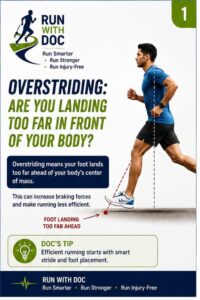
Overstriding occurs when the foot lands excessively far in front of the body’s centre of mass. Instead of allowing the body to move smoothly over the foot, this position can create a braking effect during ground contact.
The result may be a running pattern that feels less smooth, less efficient and more demanding than necessary.
But there is an important distinction:
Not every runner who heel strikes is overstriding.
And not every runner needs to change their foot strike.
The goal is to understand your individual movement pattern and make changes only when they are appropriate.
What Is Overstriding?
During running, your body moves forward while your feet repeatedly contact the ground.
With overstriding, the foot reaches significantly forward before contacting the ground.
Think of it simply:
More efficient movement:
Body → foot lands closer to the body’s centre
Overstriding:
Body → foot reaches too far forward → greater braking effect
When the foot lands too far ahead, the ground reaction force can contain a greater braking component. This may interfere with smooth forward progression.
This is why understanding running biomechanics can be useful when evaluating running form.
Why Can Overstriding Be a Problem?
When your foot lands well ahead of your centre of mass, ground contact can create greater braking forces.
Instead of smoothly continuing forward, some of your forward momentum is temporarily resisted.
For some runners, this may contribute to:
- Reduced running efficiency
- A heavier feeling while running
- Greater perceived effort
- Altered loading patterns
- Less fluid movement
However, running mechanics are highly individual.
Overstriding should not be treated as an injury diagnosis by itself.
A runner’s speed, strength, training history, body structure and overall movement pattern all matter.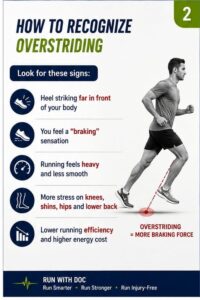
How Can You Recognize Overstriding?
There are several characteristics that may suggest excessive reaching in front of the body.
1. Your Foot Lands Far Ahead
If your lower leg appears to reach substantially forward at ground contact, it may be worth assessing your stride mechanics.
Video analysis can sometimes help identify movement patterns that are difficult to recognize while running.
2. You Feel a Braking Sensation
Does each foot strike feel as though you’re briefly putting on the brakes?
This can be a useful clue, although sensation alone cannot confirm overstriding.
3. Your Running Feels Heavy
Some runners describe their stride as heavy or less fluid when they are reaching excessively forward.
4. You Experience Recurrent Symptoms
Some runners with inefficient movement patterns may experience recurring discomfort involving the:
- Knees
- Shins
- Hips
- Feet
- Other areas
But remember:
Pain does not automatically mean overstriding.
Persistent or worsening pain should be assessed rather than automatically blamed on running form.
Should You Change Your Foot Strike?
You may see advice online such as:
“Stop heel striking!”
or
“You must land on your toes!”
Neither statement should be applied blindly.
Suddenly forcing yourself into a forefoot running pattern can shift more load toward structures such as the calf and Achilles tendon.
If your current running pattern is comfortable, efficient and sustainable, there may be no reason to make a dramatic change.
Running form should be individualized.
How Can You Reduce Overstriding?
If an assessment suggests that excessive overstriding is contributing to inefficient mechanics, several practical strategies may help.
1. Run Tall
Maintain a comfortable upright posture.
Avoid collapsing forward from the waist.
Think about keeping your body controlled and balanced as you move.
2. Use a Slight Forward Lean
A small forward lean can come from the ankles rather than bending forward at the waist.
The movement should feel natural rather than forced.
3. Don’t Reach Forward
Avoid deliberately reaching your lower leg forward to create a longer stride.
Instead, allow your foot to land naturally as your body moves forward.
4. Consider a Small Cadence Increase
For some runners, a modest increase in cadence can help reduce excessive stride length.
If you experiment with cadence, make the change gradually rather than suddenly forcing a large increase.
5. Build Strength
Strength can help you tolerate and control running loads.
Important areas may include:
- Calves
- Quadriceps
- Hamstrings
- Glutes
- Core
Strength training should complement your running rather than simply add unnecessary fatigue.
6. Progress Training Gradually
Even excellent running mechanics cannot compensate for inappropriate training progression.
Suddenly increasing mileage, intensity or frequency can increase the physical demands placed on your body.
Gradual progression is an important part of running injury prevention.
When Should You Get Your Running Technique Assessed?
A running assessment may be useful if you have:
- Recurrent running injuries
- Persistent pain
- Difficulty improving despite consistent training
- A noticeable change in running mechanics
- Repeated problems when increasing mileage
- Questions about your cadence or stride
A proper assessment should consider your whole running pattern, rather than focusing only on one factor such as foot strike or cadence.
DOC’S TIP
Don’t obsess over your foot strike.
And don’t force yourself to take tiny steps simply because you’ve read that overstriding is bad.
Instead, focus on:
- Good posture
- Controlled stride
- Appropriate cadence
- Strength
- Progressive training
- Adequate recovery
And most importantly:
Run comfortably and efficiently.
Your best running technique is not necessarily the technique that looks perfect on paper.
It is the movement pattern that allows your body to perform efficiently and sustainably.
Conclusion:
Overstriding in running means the foot is landing excessively far ahead of the body’s centre of mass, potentially creating greater braking during ground contact.
For some runners, addressing excessive overstriding may improve comfort and running efficiency.
But don’t fall into another trap by trying to completely change your running style overnight.
You don’t need to run exactly like someone else.
You need to find a running pattern that works for your body, your speed and your goals.
Run Smarter. Run Stronger. Run Injury-Free.
Frequently Asked Questions
Is heel striking the same as overstriding?
No. A runner can heel strike without necessarily overstriding. Overstriding primarily refers to the foot landing excessively far ahead of the body’s centre of mass.
Is overstriding an injury?
No. Overstriding describes a running movement pattern. It may be associated with altered mechanics or loading in some runners, but it is not an injury diagnosis.
Should I increase my cadence to 180?
Not necessarily. 180 steps per minute is not a universal target. Any cadence modification should be appropriate for your individual running pattern, speed and biomechanics.
Should I switch to forefoot running?
Not automatically. A sudden transition to forefoot running can substantially change the load placed on the calf and Achilles tendon. Technique changes should be gradual and individualized.
Can overstriding cause knee pain?
Overstriding may influence braking and loading mechanics, but running injuries can have multiple contributing factors. Knee pain should not automatically be attributed to overstriding.
How can I improve my running form?
Focus on progressive training, appropriate strength, comfortable posture, controlled movement and adequate recovery. If you have persistent symptoms or concerns about your mechanics, consider a professional running assessment.