
If you have ever used a running watch or fitness app, you have probably noticed a number called running cadence.
You may also have heard one of the most common pieces of advice in running:
“A good runner should have a cadence of 180 steps per minute.”
But is 180 steps per minute really the ideal cadence for every runner?
No.
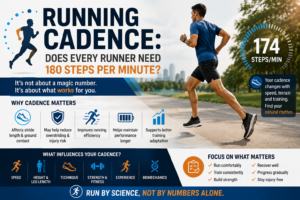
Running cadence is an important part of running technique, but there is no single cadence that is perfect for everyone. Your preferred cadence can vary depending on your running speed, body characteristics, experience, technique and individual biomechanics.
Understanding your own running pattern is much more useful than simply trying to reach an arbitrary number on your smartwatch.
What Is Running Cadence?
Running cadence is the number of steps a runner takes per minute.
For example:
- 160 steps/minute = 160 steps in one minute
- 170 steps/minute = 170 steps in one minute
- 180 steps/minute = 180 steps in one minute
Most modern GPS running watches and fitness apps can automatically measure cadence.
It is a useful metric for understanding your running pattern, but it should not be used alone to judge whether your running technique is good or bad.
Is 180 Steps Per Minute the Ideal Running Cadence?
This is one of the most common myths in recreational running.
The number 180 became popular partly because observations of elite runners have shown relatively high step rates, particularly during faster running.
But there is an important distinction:
Elite runners often have high cadence.
That does not mean:
Every runner should force their cadence to 180 steps per minute.
Cadence naturally changes with running speed. When you run faster, your step rate generally increases, but other aspects of your stride also change.
Therefore, if your natural cadence during an easy run is 160–170 steps per minute, there is no automatic reason to force yourself to 180.
Your ideal running cadence is not necessarily the number that matches an elite athlete.
What Determines Running Cadence?
Several factors influence a runner’s natural cadence.
1. Running Speed
Cadence generally changes according to running speed.
Your cadence during an easy recovery run may be different from your cadence during a tempo run, interval session or sprint.
Therefore, comparing cadence across completely different types of running can be misleading.
2. Height and Leg Length
Body dimensions can influence natural running mechanics.
Runners with different heights and leg lengths may naturally adopt different combinations of step rate and stride length.
This is another reason why copying another runner’s cadence isn’t necessarily appropriate.
3. Running Technique
Posture, stride characteristics and foot-ground interaction can influence cadence.
A change in cadence may also cause changes elsewhere in the running pattern.
This is why running technique should be assessed as a whole rather than focusing on one number.
4. Strength and Conditioning
Strength and conditioning can influence how effectively a runner produces and controls force.
Good physical preparation may help a runner tolerate running loads and maintain efficient movement as fatigue develops.
5. Running Experience
Beginners and experienced runners may develop different movement strategies over time.
As runners become more familiar with running, their technique and cadence may naturally change with training.
6. Individual Biomechanics
Every runner has a slightly different movement pattern.
Factors such as body structure, mobility, strength, previous injuries and running experience can all contribute to individual differences.
There is therefore no universal cadence that should be imposed on every runner.
Why Does Running Cadence Matter?
Cadence is closely connected with stride characteristics and ground-contact mechanics.
When cadence changes, other parts of the running pattern can change as well.
For some runners, a modest increase in cadence may:
- Reduce excessive overstriding
- Change stride characteristics
- Alter ground-contact mechanics
- Influence mechanical loading
However, these effects are individual.
That means increasing cadence is not automatically beneficial for everyone.
The goal should not be to increase cadence simply because a particular number is considered “ideal.”
Instead, cadence should be considered as one part of the overall running pattern.
Can Increasing Cadence Reduce Running Injury Risk?
This is one of the main reasons runners become interested in cadence.
Some runners may benefit from a modest cadence adjustment when addressing a specific movement or loading issue.
However, it is important not to oversimplify the relationship between cadence and injury.
Higher cadence does not automatically mean lower injury risk.
Running injuries are multifactorial.
Other factors can include:
- Training load
- Strength
- Recovery
- Footwear
- Running mechanics
- Previous injuries
- Sudden increases in running volume
- Sudden increases in training intensity
Therefore, cadence should be considered as one part of running injury prevention, rather than a standalone solution.
The Common Mistake: Chasing 180
Imagine your natural cadence during an easy run is 165 steps per minute.
You suddenly decide:
“I need to reach 180.”
You increase your step rate dramatically and try to maintain it throughout the run.
Instead of making your running better, the change may make your running feel:
- Unnatural
- Uncomfortable
- Fatiguing
- Difficult to maintain
- Less relaxed
You may also become so focused on the number that you lose the natural rhythm of your running.
Don’t let your smartwatch become your running coach.
Your data is useful, but it needs context.
A number on a watch cannot tell you everything about your running technique, physical capacity or injury risk.
Should You Increase Your Cadence?
Sometimes—but not automatically.
If a runner has a specific technical or loading issue, a sports physiotherapist, running coach or sports medicine professional may consider a cadence modification as part of a broader intervention.
The key principle is:
Make Small, Gradual Changes
If a cadence adjustment is appropriate, avoid suddenly making a large change.
Your body needs time to adapt to changes in running mechanics and loading.
Instead of trying to jump from 165 to 180 steps per minute overnight, any modification should be introduced progressively and monitored according to how the runner responds.
How Can You Improve Running Efficiency?
Rather than obsessing over one number, focus on the bigger picture.
1. Develop Good Running Technique
Work toward comfortable posture, appropriate stride characteristics and efficient movement.
Running technique should be considered in the context of your individual body and running goals.
2. Build Strength
Strength training can help improve your ability to produce and control force and tolerate the physical demands of running.
A well-rounded strength program can be an important part of running performance and running injury prevention.
3. Progress Training Gradually
Avoid sudden increases in:
- Running mileage
- Running intensity
- Training frequency
- Speed work
Your body needs time to adapt to changes in training load.
4. Prioritize Recovery
Adequate sleep, nutrition and recovery are important for maintaining training quality and allowing the body to adapt.
More training is not always better if recovery is inadequate.
5. Use Cadence as a Tool
Cadence can provide useful information about your running.
Use it to understand your running rather than allowing it to dictate every step.
What Is the Ideal Running Cadence for Beginners?
There is no single running cadence for beginners that every new runner needs to achieve.
A beginner should generally focus first on developing:
- Comfortable running
- Consistent training
- Appropriate progression
- Basic strength
- Recovery
- Good overall movement habits
Trying to immediately achieve 180 steps per minute can distract from these more important foundations.
As your running speed, fitness and experience develop, your cadence may naturally change.
When Should You Get Your Running Technique Assessed?
Consider getting a professional assessment if you experience:
- Recurrent running injuries
- Persistent pain
- Difficulty increasing your running distance
- Repeated problems despite changing footwear
- A significant change in your running mechanics
- Questions about your running form
A good assessment should look at your entire running pattern, not just your cadence.
Depending on the situation, this may include looking at training load, strength, mobility, movement patterns, previous injuries and other factors that may influence your running.
🩺 Doc’s Tip: Don’t Chase 180
Instead of asking:
“Is my cadence 180?”
Ask:
- Am I running comfortably?
- Is my stride efficient for me?
- Can I maintain my pace without excessive fatigue?
- Am I training consistently?
- Am I able to run without recurrent pain?
- Is my training load appropriate for my current capacity?
Your best cadence isn’t necessarily the number that looks best on your smartwatch.
The goal should be:
EFFICIENT + COMFORTABLE + SUSTAINABLE RUNNING
Final Takeaway
Running cadence is a useful metric—but 180 steps per minute is not a magic number.
Your cadence is influenced by:
Speed + Body Characteristics + Technique + Strength + Experience + Individual Biomechanics
If you need to change your cadence, do it gradually and for a specific reason rather than simply trying to reach an arbitrary number.
The most important goal isn’t to make your watch display a particular number.
It is to develop running that is comfortable, efficient, sustainable and appropriate for your individual needs.
🏃 Run by science—not by numbers alone.
RUN WITH DOC
Run Smarter • Run Stronger • Run Better
Dr. Yogesh Sisodia
Sports Orthopaedic Surgeon
Follow RUN WITH DOC for practical guidance on:
- Running technique
- Strength & conditioning
- Injury prevention
- Running footwear
- Recovery
- Running performance
Frequently Asked Questions
1. What is running cadence?
Running cadence is the number of steps a person takes per minute while running. For example, a cadence of 170 means approximately 170 steps are taken per minute.
2. Is 180 steps per minute the ideal running cadence?
No. 180 cadence running is not a universal requirement. Cadence varies according to running speed, body characteristics, technique, experience and individual biomechanics.
3. What is a good running cadence for beginners?
There is no single ideal cadence for every beginner. New runners should focus on comfortable, sustainable running and gradual training progression rather than trying to reach a specific number.
4. Can increasing cadence improve running technique?
For some runners, a modest cadence increase may help address specific stride or loading characteristics. However, it isn’t automatically beneficial for everyone and should be considered within the context of the individual’s overall running mechanics.
5. Can higher cadence prevent running injuries?
Not necessarily. Cadence may be one factor considered during running injury prevention, but running injuries are influenced by multiple factors, including training load, strength, recovery, footwear, previous injuries and running mechanics.