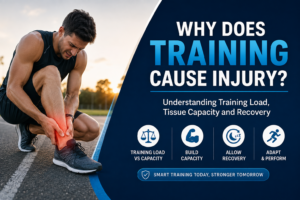
Training is essential for improving athletic performance. It helps build strength, endurance, coordination, power and sport-specific fitness. However, athletes can sometimes develop pain or injuries during training—even when exercise is part of a healthy and well-planned routine.
So, why does training cause injury?
The answer is not simply that an athlete is “training too much.” Injury risk is influenced by the relationship between training load, tissue capacity, recovery, adaptation and the individual athlete’s circumstances.
Understanding this relationship is an important part of sports injury prevention and safe performance progression.
What Is Training Load?
Training load refers to the overall physical stress placed on the body during training and competition.
It can include:
- Running
- Sprinting
- Jumping
- Strength training
- Throwing
- Change-of-direction drills
- Skill-based training
- Matches and competitions
Training load isn’t determined only by how long an athlete exercises. The overall demand can also be influenced by volume, intensity, frequency and duration.
For example, running 5 kilometres at a comfortable pace creates a very different physical stimulus from running the same distance with repeated maximal sprints.
This is why training load and injury need to be considered in context rather than judged by exercise duration alone.
Your Body Has a Limited Current Capacity
Every athlete has a current level of physical capacity—the amount of stress their body is prepared to tolerate at a particular time.
This includes the ability of:
- Muscles to produce and tolerate force
- Tendons to tolerate repeated loading
- Bones to tolerate impact
- Joints to tolerate movement
- The cardiovascular system to tolerate exercise
- The nervous system to coordinate movement
- The body to recover between training sessions
Importantly, this capacity isn’t fixed.
With appropriate training and recovery, the body can gradually adapt and become stronger. However, different tissues and physical qualities adapt at different rates, so increasing training demands too quickly can create problems.
Training Load vs. Tissue Capacity
A useful way to understand training-related injury is to compare what you ask the body to do with what the body is currently prepared to tolerate.
When training is appropriately matched to capacity:
Training Load ≤ Current Capacity
The body can adapt to the stimulus and gradually become better prepared for future demands.
When training demands suddenly exceed capacity:
Training Load > Current Capacity
The tissues and physical systems may be exposed to excessive stress, potentially increasing injury risk.
However, this should not be treated as a simple mathematical formula that predicts exactly who will get injured. Sports injuries are complex and can be influenced by multiple factors.
Why Can the Same Workout Affect Two Athletes Differently?
Imagine two football players completing exactly the same training session.
Athlete A
- Has trained consistently
- Has good strength and conditioning
- Is accustomed to the training demands
- Has adequate recovery
Athlete B
- Has recently returned from an injury
- Has had several weeks of reduced training
- Has lower conditioning
- Is fatigued
- Is suddenly exposed to high-intensity training
Although both athletes experience the same external training load, their ability to tolerate that load may be completely different.
This is why there isn’t one universal amount of training that can be considered “safe” or “unsafe” for every athlete.
Training history, fitness, previous injuries, fatigue, recovery and the demands of the sport all matter.
How Sudden Changes in Training Can Increase Injury Risk
One of the most important principles in sports injury prevention is appropriate progression.
Sometimes the problem isn’t the absolute amount of training. The bigger issue may be how quickly the athlete reached that level.
Consider an athlete running:
- Week 1: 10 km
- Week 2: 12 km
- Week 3: 14 km
This represents a gradual progression.
Now compare that with:
10 km → 25 km in one week
That represents a substantially different training demand and may be difficult for an athlete who hasn’t developed the capacity to tolerate it.
The same principle applies to sudden increases in sprinting, jumping, strength training, match exposure or high-intensity sessions.
Is there a perfect percentage increase?
No single percentage can guarantee injury prevention for every athlete.
Training progression needs to consider the individual’s current capacity, training history, recovery, sport and overall circumstances rather than relying on a rigid formula.
Recovery Is Part of Training
Recovery is sometimes treated as time away from training.
In reality, recovery is an essential part of the training process.
Training provides the stimulus.
Recovery provides the opportunity for adaptation.
The basic process can be thought of as:
TRAIN → RECOVER → ADAPT → PROGRESS
Rather than:
TRAIN → TRAIN → TRAIN → BREAK DOWN
Repeatedly increasing training stress without adequate recovery can create problems. Training errors can include neglecting recovery, increasing demands too quickly, returning too rapidly after illness or injury, excessive high-volume or high-intensity training, and insufficient recovery between demanding sessions.
Why More Training Isn’t Always Better
Training generally produces beneficial adaptations, but increasing training indefinitely does not necessarily produce better results.
At a certain point, additional training may provide diminishing returns, particularly when recovery is insufficient.
The goal shouldn’t be:
“Train as much as possible.”
Instead, the goal should be:
“Apply the amount of training that produces the desired adaptation while allowing adequate recovery.”
This becomes particularly important for athletes training at high levels, where the difference between sufficient training and excessive training can become relatively small.
Training Load and Injury During Return to Sport
The relationship between training load and tissue capacity becomes particularly important after an injury.
An athlete may feel pain-free, but being pain-free doesn’t necessarily mean the body has regained the capacity required for high-level sport.
For example, a football player returning after injury may need to progress through:
Walking → Jogging → Running → Sprinting → Cutting → Jumping → Football Drills → Training → Competition
Each stage increases the physical demands placed on the body.
A structured return to sport process allows the athlete to gradually bridge the gap between their current capacity and the demands of their sport.
This is an important component of sports injury rehabilitation.
5 Ways to Reduce Training-Related Injury Risk
There is no single formula that can eliminate sports injuries. However, several practical principles can help athletes manage training demands.
1. Progress Training Gradually
Avoid sudden and major increases in training volume or intensity.
The body needs time to adapt to new physical demands.
2. Build Physical Capacity
Develop the physical qualities required by the sport, including:
- Strength
- Endurance
- Power
- Mobility
- Neuromuscular control
- Sport-specific fitness
The stronger and better prepared the athlete is for a particular demand, the better positioned they may be to tolerate that demand.
3. Prioritize Recovery
Hard training requires appropriate recovery.
Organizing demanding and easier sessions appropriately can help provide the body with time to recover between high-stress sessions.
4. Individualize Training
Two athletes can respond differently to exactly the same training program.
Training should consider:
- Training history
- Fitness
- Previous injuries
- Current symptoms
- Fatigue
- Recovery
- Sport
- Competition schedule
5. Monitor the Athlete’s Response
Don’t look only at the training plan. Pay attention to how the athlete responds.
Changes in:
- Performance
- Pain
- Muscle soreness
- Fatigue
- Sleep
- General well-being
can provide useful information when deciding whether training needs to be modified.
The Most Important Lesson About Training and Injury
Training itself is not the enemy.
Appropriate training is one of the most effective ways to make athletes stronger, fitter and more resilient.
The problem can arise when:
Training demands increase faster than the athlete’s ability to adapt.
Therefore, effective sports medicine isn’t simply about telling an athlete to “train less.”
Instead, the important questions are:
- What can the athlete tolerate today?
- What does their sport require?
- What is their current physical capacity?
- How can that gap be bridged safely?
A simple sports medicine principle:
BUILD CAPACITY → PROGRESS LOAD → ALLOW RECOVERY → ADAPT → PERFORM
The goal isn’t to avoid training load.
The goal is to build the capacity to handle it.
When Should an Athlete See a Sports Medicine Specialist?
Not every ache after training indicates a serious injury. However, athletes shouldn’t simply continue training through symptoms that persist or worsen.
A sports medicine assessment may be appropriate when there is:
- Persistent or progressively worsening pain
- Recurrent swelling
- Loss of function
- Changes in normal movement
- Symptoms that repeatedly return during training
Assessment can help determine whether the problem is related to training load, tissue capacity, technique, recovery, an underlying injury or a combination of factors.
Early assessment can be particularly valuable when symptoms are affecting training performance or preventing an athlete from progressing through rehabilitation.
Conclusion
So, why does training cause injury?
Sports injuries are rarely as simple as doing “too much exercise.” Injury risk depends on the relationship between training load, tissue capacity, recovery, adaptation and individual circumstances.
Training provides the stimulus that allows the body to adapt. Gradual progression gives the body an opportunity to become stronger and better prepared for sporting demands. But when training demands increase too quickly, recovery is inadequate, or current physical capacity is not sufficient for the demands being placed on the body, injury risk may increase.
The objective isn’t to avoid training.
It’s to build the capacity to handle it.
Frequently Asked Questions
1. Why does training cause injury?
Training can increase injury risk when physical demands increase faster than the body’s ability to adapt. Training load, tissue capacity, recovery and individual factors all influence injury risk.
2. What is training load?
Training load is the overall physical stress placed on an athlete during training and competition. It can include running, sprinting, jumping, strength training, drills and matches.
3. Can increasing training too quickly cause injury?
A sudden increase in training demands can increase stress on tissues that may not yet be prepared for the new workload. Gradual progression allows the body more time to adapt.
4. How does recovery help prevent sports injuries?
Recovery allows the body to respond and adapt to the stress created by training. Insufficient recovery between demanding sessions can contribute to excessive physical stress.
5. What is the importance of sports injury rehabilitation?
Sports injury rehabilitation helps an athlete progressively rebuild the physical capacity required for their sport. The process may involve gradually progressing from basic movement to running, sprinting, sport-specific drills, training and eventually competition.