
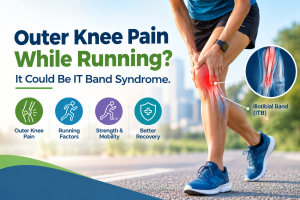
Experiencing pain on the outside of your knee while running? Does your run start comfortably, but after a few minutes or kilometres, you begin feeling discomfort around the outer side of your knee?
One possible cause is Iliotibial Band Syndrome (ITBS), a common running-related condition that affects the outer aspect of the knee.
ITBS is often associated with repetitive running activities, changes in training load and individual movement patterns. However, there is no single cause that explains every case. Training intensity, running exposure, strength, recovery and biomechanics may all contribute.
Understanding why ITBS develops and how to manage it can help runners make informed decisions about recovery and returning to training.
If you experience persistent outer knee pain, an assessment by a professional experienced in sports injury treatment in Pune can help identify the underlying problem.
What Is Iliotibial Band Syndrome (ITBS)?
The iliotibial band (ITB) is a strong band of connective tissue that runs along the outer side of the thigh, extending from the hip region towards the outer part of the knee.
It plays a role in stabilising the lower limb during activities such as walking, running and cycling.
Iliotibial Band Syndrome (ITBS) is a condition commonly associated with pain around the outer side of the knee, particularly during repetitive activities such as running.
Historically, ITBS was often explained as a friction problem caused by the iliotibial band repeatedly rubbing against structures near the knee. However, current biomechanical explanations are more complex, and the exact mechanism responsible for pain is not completely established.
Common Symptoms of ITBS
Runners with ITBS may experience:
- Pain on the outside of the knee.
- Discomfort that develops after running for a certain distance or duration.
- Pain that becomes more noticeable as running continues.
- Increased discomfort during downhill running.
- Symptoms that return when training volume or intensity increases.
A common pattern is that running initially feels comfortable, but pain gradually develops after a certain period.
However, not every case of outer knee pain is ITBS. Other knee conditions can produce similar symptoms, making proper assessment important.
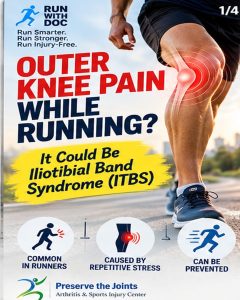
Why Does ITBS Happen in Runners?
ITBS is considered a multifactorial running-related condition. This means several factors may contribute rather than one specific problem being responsible.
Let’s understand some common factors.
A. Sudden Changes in Training Load
One of the important factors to consider is how quickly your running workload changes.
For example:
- Increasing weekly running distance suddenly.
- Adding extra running sessions.
- Increasing running speed or intensity.
- Introducing sprint training without preparation.
- Increasing hill or downhill running.
When training demands increase faster than the body can adapt, symptoms may develop.
This is why the principle of “too much, too soon” is important in running injury management.
A gradual increase in training exposure gives the body an opportunity to adapt to changing demands.
B. Hill and Downhill Running
Running on hills changes the demands placed on the lower limbs.
Downhill running, in particular, involves repeated loading and braking forces. If you suddenly introduce substantial downhill running into your training programme, it may contribute to symptoms in a susceptible runner.
This does not mean hills are bad for runners. Instead, hill training should be introduced progressively according to your current fitness and training experience.
C. Individual Running Mechanics
Running involves coordinated movement of the hips, knees, ankles and feet.
Research has identified associations between certain hip and knee movement patterns and ITBS. However, findings are not consistent enough to establish one universal running technique that causes the condition.
There is no single perfect running form that every runner must follow.
Instead, running mechanics should be assessed individually, considering factors such as:
- Hip and knee movement.
- Lower-limb control.
- Running speed.
- Training volume.
- Individual strength and mobility.
Changing your running technique without understanding your movement pattern may not solve the problem.
When Should You See a Sports Medicine Professional?
Outer knee pain is not always caused by ITBS. Other conditions, including meniscus problems, ligament injuries and other sources of lateral knee pain, may produce similar symptoms.
Consider professional assessment if:
- Pain persists despite modifying your training.
- Symptoms become progressively worse.
- Pain repeatedly returns when you resume running.
- Walking or everyday activities become uncomfortable.
- You are unsure whether the problem is actually ITBS.
- You experience significant swelling, locking or instability.
Seek prompt medical assessment following a significant injury, particularly if you cannot bear weight, the knee becomes severely swollen or you experience substantial instability.
A qualified orthopaedic surgeon in Pune or sports medicine professional can assess the knee, review your running history and help determine whether further investigations are needed.
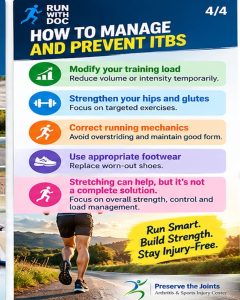
How Can Runners Reduce the Risk of ITBS?
There is no guaranteed way to prevent ITBS, but sensible training habits can help manage unnecessary training stress.
1. Increase Training Gradually
Avoid sudden increases in weekly mileage, running frequency or intensity. Give your body time to adapt to new demands.
2. Include Strength Training
Maintain appropriate strength in the hips, gluteal muscles, quadriceps and other lower-limb muscles.
3. Respect Recovery
Allow enough time between demanding sessions, especially when introducing speed work or hill training.
4. Introduce New Terrain Progressively
If you are planning to add downhill running or challenging routes, gradually build your exposure.
5. Avoid Chasing a Perfect Running Form
Running mechanics differ between individuals. Do not force changes based on a single rule or a general recommendation.
6. Pay Attention to Early Symptoms
If outer knee discomfort repeatedly appears during running, review your training load instead of continuing to increase distance or intensity.
If knee pain starts affecting your daily activities or training consistency, consider knee pain treatment in Pune through an appropriate clinical assessment.
How Long Does ITBS Take to Recover?
Recovery time varies between runners. It depends on symptom severity, how long the problem has been present, training demands and the individual’s response to rehabilitation.
Some runners improve after modifying their training and following an appropriate strengthening programme. Others may need a longer period of rehabilitation before returning to their previous running level.
Rather than following a fixed recovery timeline, focus on:
- Improving pain and symptom tolerance.
- Rebuilding lower-limb strength.
- Regaining comfortable movement.
- Gradually increasing running exposure.
- Returning to speed work and hills when appropriate.
The aim is to return to running without repeatedly provoking the same symptoms.
Frequently Asked Questions About ITBS
1. What is the main symptom of iliotibial band syndrome?
The most common symptom is pain around the outer side of the knee, particularly during repetitive activities such as running. Discomfort may develop after a certain distance or duration.
2. Can I continue running with ITBS?
It depends on your symptoms and the severity of the problem. Some runners may continue modified activity, while others need a temporary reduction or pause in running. Persistent or worsening pain should be assessed.
3. Does stretching cure ITBS?
No. Stretching alone is not considered a complete treatment. Rehabilitation may involve load modification, progressive strengthening and a gradual return to running.
4. Are weak hip muscles responsible for ITBS?
Hip strength may be relevant in some runners, but hip weakness has not been established as the universal cause of ITBS. Strength and movement should be assessed individually.
5. Can downhill running cause ITBS?
Downhill running changes the demands placed on the lower limbs. A sudden increase in downhill exposure may contribute to symptoms in susceptible runners.