
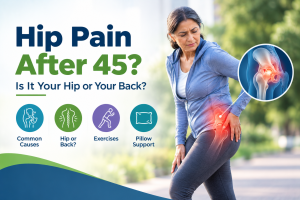
Is Your Hip Pain Really Coming From Your Hip?
Pain around your hip does not always mean the problem lies inside the hip joint. Discomfort in the groin, outer hip, buttock or thigh may originate from the hip joint, surrounding muscles and tendons, or the lower back.
After the age of 45, understanding the source of hip pain becomes particularly important. The right diagnosis can help you choose appropriate treatment, maintain mobility and continue everyday activities with greater confidence.
At Healthy Joints Club 45+, the focus is on helping adults understand joint health, stay active and maintain independence as they age.
In this article, we explore the common causes of hip pain, the differences between hip-related and back-related pain, how the condition is assessed, and when professional care may be needed.
Why Does Hip Pain Become More Common After 45?
The hip is a major weight-bearing joint. It supports your body when you walk, climb stairs, stand up from a chair and perform everyday movements.
The joint relies on several structures working together, including cartilage, bones, muscles, tendons, ligaments and surrounding nerves. Changes in these structures, previous injuries, reduced physical activity and repetitive loading may contribute to discomfort.
Pasted text.txt
Common causes include the following.
Hip Osteoarthritis
Hip osteoarthritis involves changes in the cartilage and other tissues of the joint. It may cause pain, stiffness and reduced movement.
Common symptoms include:
- Pain around the groin or front of the hip.
- Stiffness after sitting or resting.
- Discomfort while walking or climbing stairs.
- Difficulty putting on socks or shoes.
- Reduced ability to bend or rotate the hip.
The severity of symptoms varies. Some people have noticeable changes on an X-ray but few symptoms, while others experience considerable discomfort.
Muscle and Tendon Problems
The muscles and tendons surrounding the hip help stabilise the joint and control movement. Problems affecting these tissues may cause pain even when the hip joint itself is not the main source.
For example, irritation of the gluteal tendons may cause pain over the outer side of the hip. It may become more noticeable when walking, climbing stairs or lying on the affected side.
Pain Originating From the Lower Back
The lower back and hip region are closely connected through muscles, movement and nerves. Conditions affecting the lumbar spine may cause pain in the buttock or thigh and sometimes feel like a hip problem.
This is why treating every painful hip as a joint problem may lead to an inappropriate treatment approach.
How Is the Actual Cause of Hip Pain Diagnosed?
An accurate diagnosis usually begins with a detailed medical history and physical examination. Imaging may be useful, but the appropriate investigation depends on the clinical findings.
Pasted text.txt
Step 1: Understanding Your Symptoms
Your doctor may ask questions such as:
- Where exactly do you feel the pain?
- When did it begin?
- Does walking make it worse?
- Is climbing stairs or standing up difficult?
- Do you also experience lower-back pain?
- Does the pain travel down your leg?
- Have you noticed tingling, numbness or weakness?
- Did the symptoms begin after an injury or a change in activity?
These details help narrow down the possible causes.
Step 2: Examining Movement and Function
Depending on your symptoms, the examination may include:
- Observing your walking pattern.
- Assessing hip movement and flexibility.
- Checking muscle strength.
- Examining the lower back.
- Evaluating relevant nerve function.
- Assessing balance and functional movements.
The aim is to determine which movements reproduce your pain and whether the findings suggest a joint, muscle, tendon or spinal problem.
Step 3: Choosing Appropriate Investigations
An X-ray may be recommended when hip osteoarthritis or another bony condition is suspected. Ultrasound, MRI or other investigations may be useful in selected cases involving soft tissues or other conditions that need further clarification.
Not everyone with hip pain requires an MRI. Imaging findings must also be interpreted alongside symptoms because structural changes on a scan are not always the cause of the pain.
If you are looking for an orthopaedic surgeon for hip pain in Pune, consider an assessment that evaluates both the hip and the lower back when your symptoms suggest that either area may be involved.

What Is the Treatment for Hip Pain After 45?
Treatment depends on the underlying diagnosis, symptom severity and the effect of pain on daily activities. There is no single treatment suitable for every person.
Pasted text.txt
Exercise and Physiotherapy
For many musculoskeletal hip conditions, an appropriately designed rehabilitation programme can help improve strength, movement and everyday function.
Depending on the diagnosis, a programme may include:
- Hip muscle strengthening.
- Gluteal muscle training.
- Exercises to improve hip mobility.
- Balance and functional training.
- Gradual improvements in walking tolerance.
- Exercises to improve overall lower-limb strength.
People with hip osteoarthritis may benefit from tailored therapeutic exercise. The programme should take account of pain levels, mobility, general health and individual goals.
The aim is not only to manage discomfort but also to support movement, confidence and independence.
When Should You See an Orthopaedic Surgeon?
Occasional mild discomfort may improve with appropriate activity modification. However, persistent or worsening hip pain should not be ignored.
Arrange a clinical assessment if you experience:
- Hip pain that persists or repeatedly returns.
- Increasing difficulty walking or climbing stairs.
- Pain that interferes with sleep or everyday activities.
- Progressive stiffness or reduced hip movement.
- Pain travelling down the leg.
- Tingling, numbness or weakness.
- Difficulty determining whether the pain originates from the hip or lower back.
Pasted text.txt
Seek urgent medical attention if you develop sudden, severe hip pain without a clear explanation, cannot bear weight after an injury, or have a hot or swollen hip with fever or feel unwell. New or progressive leg weakness, significant difficulty walking or new bladder or bowel dysfunction—particularly with back pain or leg symptoms—also require urgent assessment.
Pasted text.txt
An orthopaedic doctor in Pune can assess your symptoms and help determine whether further investigations, rehabilitation or specialist treatment may be appropriate.
Five Practical Habits for Better Hip Health After 45
Although not every cause of hip pain can be prevented, several habits may help maintain strength, mobility and physical function.
Pasted text.txt
1. Stay Physically Active
Choose activities that suit your health and fitness, such as walking, cycling or other comfortable forms of exercise.
2. Strengthen the Muscles Around Your Hips
The hip and surrounding muscles contribute to walking, standing and everyday movement. A suitable strengthening programme can help maintain functional capacity.
3. Avoid Prolonged Inactivity
Break up long periods of sitting with regular movement. If you have been inactive for some time, begin gradually.
4. Maintain a Healthy Body Weight
If weight management is appropriate for you, combine sustainable dietary habits with suitable physical activity.
5. Investigate Persistent Pain Rather Than Guessing
Do not assume that every episode of hip pain is caused by arthritis, ageing or muscle weakness. Understanding the source helps guide the treatment plan.
Frequently Asked Questions About Hip Pain After 45
1. How do I know whether my hip pain is coming from my hip or my back?
Groin pain and restricted hip rotation may suggest a hip-joint problem, while pain radiating from the back into the buttock or leg may indicate spinal or nerve involvement. However, symptoms overlap, so a clinical examination is needed to distinguish possible causes.
2. Can hip osteoarthritis cause pain in the thigh?
Yes. Hip osteoarthritis can cause pain in the groin, thigh or sometimes the buttock. The distribution varies between individuals and does not establish the diagnosis on its own.
3. Does outer hip pain always mean arthritis?
No. Outer hip pain may arise from the gluteal tendons, surrounding soft tissues or other conditions. An assessment can help identify the source.
4. Is walking good for hip pain?
Walking may be suitable for many people with hip pain, including some people with hip osteoarthritis. However, distance and intensity should be adjusted according to symptoms and the underlying diagnosis. Severe, unexplained or worsening pain should be assessed rather than repeatedly pushed through.
5. Can hip pain be treated without surgery?
Many causes of hip pain can be managed without surgery. Depending on the diagnosis, treatment may include exercise, physiotherapy, activity modification, weight management and medication. Surgery may be considered for particular conditions when appropriate.