Runner’s Knee: C
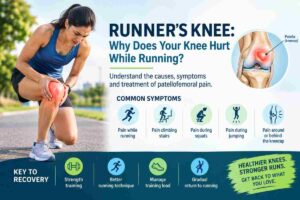
auses, Symptoms & Treatment of Patellofemoral Pain
Running is one of the simplest and most effective ways to stay fit. But when pain starts developing around the front of your knee during running, climbing stairs or squatting, you may begin to wonder:
“Is something wrong with my kneecap?”
One common cause of this type of pain is patellofemoral pain, often referred to as runner’s knee.
Patellofemoral pain is generally felt around or behind the kneecap and can become worse during activities that load the knee while it is bent, such as running, squatting and climbing stairs.
For runners dealing with persistent knee pain while running, understanding the cause and managing training appropriately can be an important part of recovery.
What Is a Runner’s Knee?
“Runner’s knee” is a commonly used term for patellofemoral pain.
The pain is usually felt around or behind the patella (kneecap) and may become noticeable during:
Running
Going up or down stairs
Squatting
Jumping
Prolonged periods of knee bending
Importantly, runner’s knee does not automatically mean that the cartilage underneath the kneecap is damaged.
The term patellofemoral pain is generally preferred rather than automatically describing every case as chondromalacia.
Why Do Runners Develop Knee Pain?
There is rarely one single explanation that applies to every runner.
Patellofemoral pain can be influenced by the interaction between the runner, training load and physical capacity.
Understanding these factors is important for running injury prevention and effective rehabilitation.
1. Sudden Changes in Training
One common factor is a sudden increase in running demands.
For example, you may have suddenly increased:
Running distance
Number of running days
Speed work
Hill running
Long-run duration
Overall training intensity
Your body needs time to adapt to changes in physical loading.
If training demands increase faster than your current capacity, symptoms may develop or become aggravated.
This is why gradual progression is an important part of managing runner knee pain.
2. Physical Capacity
Running repeatedly places demands on the muscles and joints of the lower limb.
Your ability to tolerate these demands can be influenced by:
Strength
Conditioning
Previous injuries
Training history
Recovery
Current workload
Exercise-based management is an important component of evidence-based treatment for patellofemoral pain.
A rehabilitation programme may therefore focus on gradually developing the physical capacity required for your individual running demands.
3. Running Demands
Every runner has a different combination of:
Running speed
Stride characteristics
Cadence
Training volume
Strength
Running experience
Previous injury history
This means there is no single running technique that guarantees protection from runner’s knee.
Instead of immediately blaming your footwear, foot strike or running form, it is more useful to look at the whole runner.
What Does a Runner’s Knee Feel Like?
Typical symptoms of patellofemoral pain can include discomfort:
Around or behind the kneecap
During running
While climbing stairs
During squats
During jumping
After prolonged periods of knee bending
The defining feature is generally pain around or behind the patella that is aggravated by activities that load the patellofemoral joint.
However, not every type of pain at the front of the knee is necessarily runner’s knee.
That is why persistent or unusual symptoms should be properly assessed.
Should You Stop Running?
Not every runner with patellofemoral pain needs to permanently stop running.
The appropriate approach depends on several factors, including:
Severity of symptoms
Training load
Irritability of the condition
Current physical capacity
Running goals
Functional requirements
In some situations, temporarily modifying running may be appropriate.
This could mean reducing running volume or intensity before progressively building back toward normal training.
The objective isn’t simply:
“Stop running.”
The objective is:
“Build the capacity to run comfortably again.”
What About Strength Training?
Strength training is an important component of managing patellofemoral pain.
Depending on the individual, a rehabilitation programme may include exercises targeting:
Quadriceps
Hip muscles
Gluteal muscles
Lower-limb strength and control
Hip- and knee-targeted exercise commonly forms an important foundation of rehabilitation for patellofemoral pain.
However, there is no single exercise programme that is perfect for every runner.
The exercises, intensity and progression should be individualized according to the runner’s symptoms, physical capacity and goals.
This is particularly important when seeking knee pain treatment in Pune, where runners may have very different training backgrounds and sporting demands.
Can Running Form Cause Runner’s Knee?
This is where runners can sometimes become confused.
There is no single “perfect” running technique that applies to everyone.
Your running mechanics are influenced by multiple factors, including:
Cadence
Stride characteristics
Strength
Mobility
Running speed
Training load
Individual biomechanics
Changing cadence or stride may be useful for selected runners, but it should not be done simply because someone says:
“Your running form is wrong.”
A proper assessment should consider:
Training Load + Strength + Running Capacity + Symptoms + Goals
Rather than focusing on one movement or one number, the aim should be to understand why the runner is experiencing symptoms and what changes may help.
How Can You Manage a Runner’s Knee?
Managing patellofemoral pain often involves more than simply resting the knee.
A comprehensive approach may include:
1. Managing Training Load
Temporarily modifying running volume, intensity or frequency may help reduce excessive stress while symptoms settle.
2. Building Strength
Progressive strengthening can help develop the capacity required for running.
3. Gradual Return to Running
Once symptoms are appropriately controlled, running can be progressively reintroduced according to individual tolerance.
4. Addressing Contributing Factors
Depending on the runner, this may involve considering strength, running mechanics, recovery, training history and other relevant factors.
5. Monitoring Symptoms
Your response to training can provide useful information about whether your current running load is appropriate.
The goal is not simply to eliminate pain temporarily.
It is to help the runner return to consistent and sustainable running.
When Should You See a Sports Orthopaedic Specialist?
Consider getting assessed if:
Knee pain persists
Pain is progressively worsening
You cannot run normally
Pain interferes with daily activities
There is significant swelling
The knee locks or gives way
You have experienced significant trauma
Symptoms do not improve despite appropriate training modification
If you’re looking for a sports orthopaedic surgeon in Pune for persistent running-related knee problems, a proper clinical assessment can help determine whether the symptoms are consistent with patellofemoral pain or whether another condition needs to be considered.
Not every anterior knee pain is runner’s knee.
Why You Shouldn’t Ignore Persistent Knee Pain
It can be tempting for runners to simply continue training through pain.
But repeatedly running through symptoms without understanding the underlying problem may make it harder to maintain consistent training.
Instead, consider the bigger picture:
Training Load
↓
Physical Capacity
↓
Running Mechanics
↓
Recovery
↓
Symptoms
↓
Running Goals
This approach helps shift the focus from simply treating the painful knee to understanding the needs of the entire runner.
For runners searching for runner’s knee treatment in Pune, an individualized assessment can help determine the most appropriate approach based on symptoms, activity level and goals.
A Runner-Focused Approach
Don’t just treat the knee.
Treat the runner.
A good assessment should consider:
Training load
Strength
Running capacity
Recovery
Individual biomechanics
Previous injuries
Running goals
Education combined with appropriate physical interventions can be more useful than simply taking a “wait and see” approach.
The objective is to help the runner understand their symptoms, manage their training and progressively rebuild the capacity needed for running.
Conclusion
If the front of your knee hurts while running, climbing stairs or squatting, patellofemoral pain is one possible cause.
But don’t immediately blame your shoes, foot strike or kneecap.
Look at the whole picture.
Build strength.
Manage training load.
Progress gradually.
Allow adequate recovery.
And if the pain persists, get assessed rather than repeatedly running through it.
Your goal isn’t simply to stop the pain.
Your goal is to build the capacity to run comfortably again.
Frequently Asked Questions
1. What is runner’s knee?
Runner’s knee is a commonly used term for patellofemoral pain. It typically causes pain around or behind the kneecap that can become worse with running, squatting, stairs and other activities that load the knee while bent.
2. Why does my knee hurt when I run?
Knee pain while running can have several possible causes. Patellofemoral pain is one common possibility, but training load, physical capacity, previous injuries and other factors can contribute to symptoms.
3. Should I stop running if I have runner’s knee?
Not necessarily. Depending on the severity and irritability of symptoms, temporary modification of running may be appropriate, followed by a gradual return as capacity improves.
4. Can strength training help runner’s knee?
Yes. Exercise-based management is an important part of patellofemoral pain rehabilitation. Depending on the individual, strengthening may target the quadriceps, hip muscles, gluteal muscles and other lower-limb muscles.
5. Can changing running cadence help knee pain?
A cadence modification may be useful for selected runners, but it is not automatically necessary for everyone. Running technique should be assessed as part of the bigger picture rather than
focusing on one number.